Donburi
Donburi
Donburi
Board Game
Board Game
Board Game
Overview
Overview
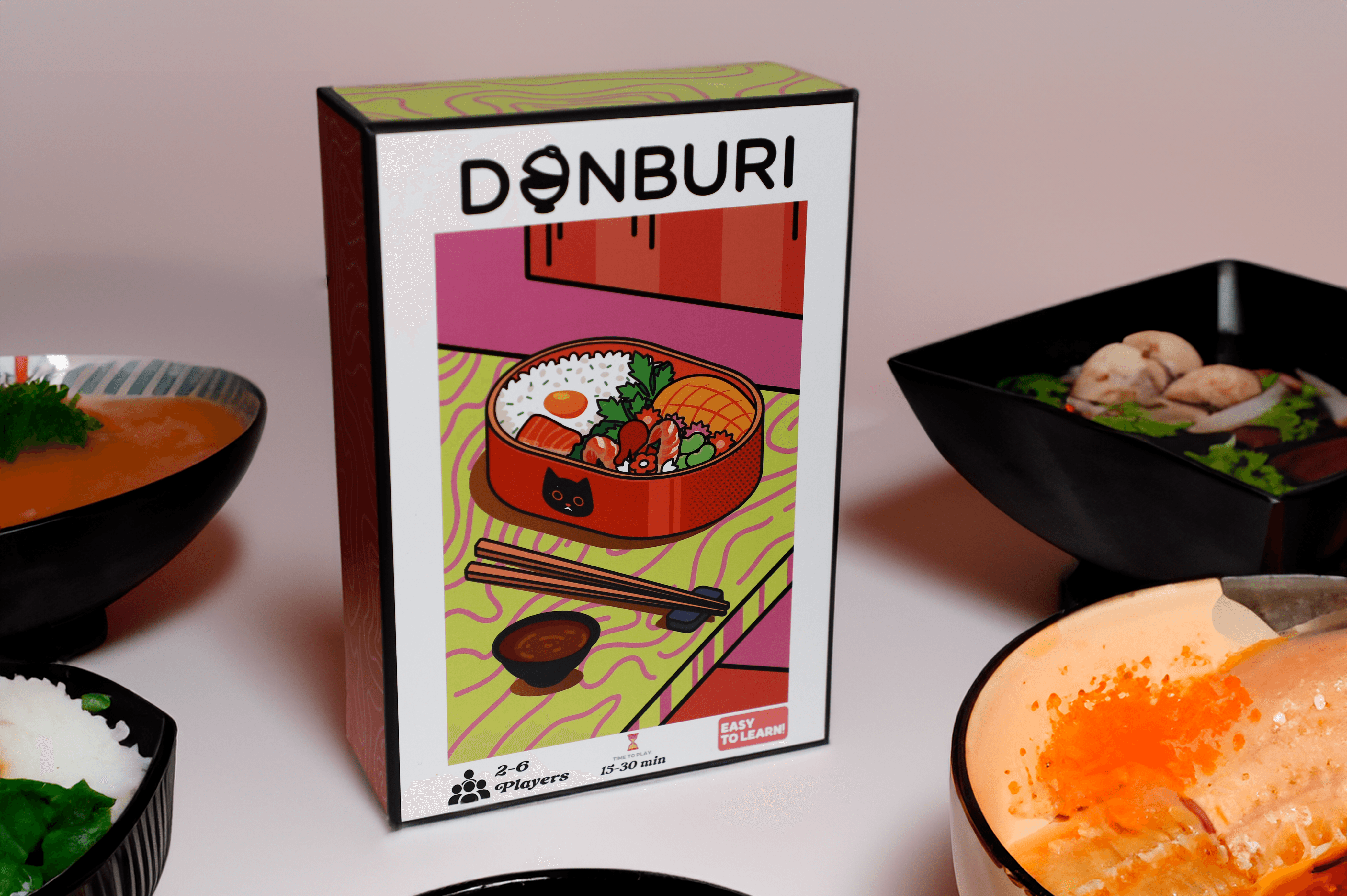
Donburi is a recipe building card game created and manufactured by me. This is the second game I designed as part of my board game company: SmartMove Card Games
Donburi is a recipe building card game created and manufactured by me. This is the second game I designed as part of my board game company: SmartMove Card Games
The objective of Donburi is to be the first player to reach 100 points by creating different recipes by collecting "ingredients" that come through the fictional "market". The various recipes are listed within a menu refernce card and recipes that involve rarer ingredients or more ingredients reward the user with more points when they create that dish. Each time a dish is created, players pick up an "action card" which adds a twist and the fun aspect to the game by allowing players to perform different actions like being able to steal ingredients from other players, have a magic card that acts as any ingredient, score points when another player completes a recipe, and much more.
The objective of Donburi is to be the first player to reach 100 points by creating different recipes by collecting "ingredients" that come through the fictional "market". The various recipes are listed within a menu refernce card and recipes that involve rarer ingredients or more ingredients reward the user with more points when they create that dish. Each time a dish is created, players pick up an "action card" which adds a twist and the fun aspect to the game by allowing players to perform different actions like being able to steal ingredients from other players, have a magic card that acts as any ingredient, score points when another player completes a recipe, and much more.
Tools Used

Figma
Design Tool

Photoshop
Design Tool

Illustrator
Programming Language

Procreate
Design Tool
Tools Used
Figma
Design Tool
Photoshop
Design Tool
Illustrator
Programming Language
Procreate
Design Tool
Tools Used
Figma
Design Tool
Photoshop
Design Tool
Illustrator
Programming Language
Procreate
Design Tool
Created
Created
2023

Process
Process
Early Iterations
The original inspiration and concept came from my love for anime and Japanese food. I wanted the art style to be different from my other card game to practice being able to design a game in a different aesthetic and theme. I had actually taken inspiration for the box artwork from another artist on Behance who really liked my concept and allowed me to take her cereal box mockup and convert the design into a card game
I kept the same color palette as the inspiration mockups of the cereal box, but when designing the cards, I wanted them to have a simple, minimal look to them that makes the game easy to play and comprehend. When developing the rules, it took months of playtesting with designs drawn on pieces of paper in order to keep the game balanced before actually fully flushing out the artwork for the game.
Design Decisions
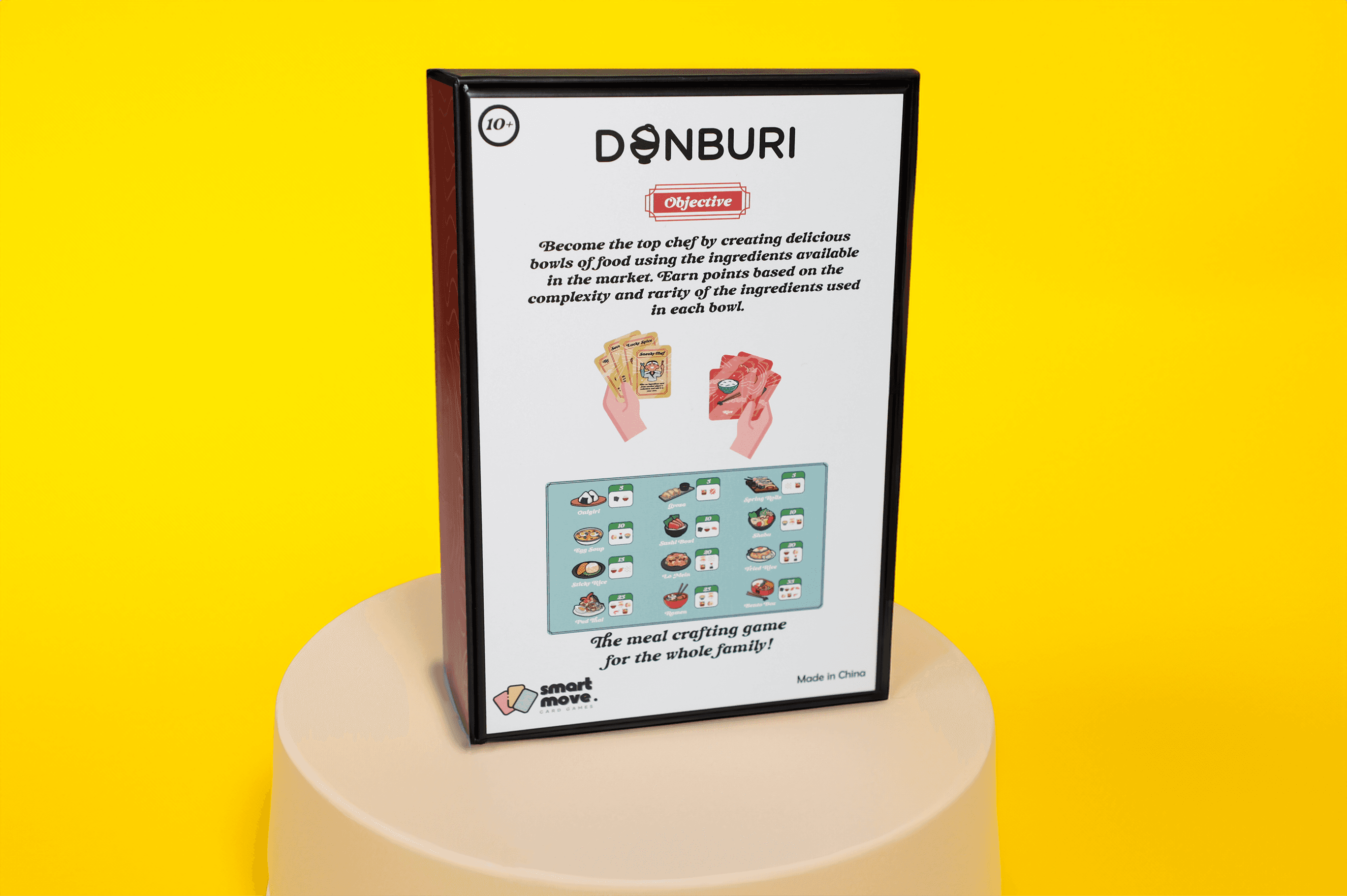
The whole visual identity started with illustration styles I was seeing on Behance. I wanted that bright, saturated, cartoony look where everything pops off the surface, and it made sense for a game literally themed around building donburi bowls. Every card uses bold outlines and flat color fills so the ingredients are instantly recognizable even when you're holding a hand of cards and glancing quickly. The red and yellow card backs tie into that same warm, food-inspired palette, and the teal reference sheet acts as a nice contrast piece so it's easy to spot on the table mid-game. I also snuck a little black cat face onto the bento box on the cover, which was just a small personality touch to make the brand feel less generic and more memorable.
I spent a lot of time thinking about how the cards would actually feel during gameplay. The ingredient cards needed to communicate what they are instantly, so each one has a large centered illustration with the name right below it and the point value clearly visible. The "action" cards use a completely different color treatment (yellow instead of red) so you can immediately tell they're special cards before reading any text. I kept the card text minimal on purpose because nobody wants to stop mid-turn and read a paragraph. If the card art and layout can't explain themselves in a couple seconds, something went wrong in the design.
The physical product was something I cared a lot about because I think the unboxing experience sets the tone for how people perceive the game before they even play it. I wanted it to feel like you're opening an actual bento box, where everything has its place and is neatly arranged for you to discover. Inside, the rule sheet, reference card, point tokens, and card decks are all designed around the same visual system with consistent colors, icons, and typography so nothing feels like an afterthought. The green point tokens, teal reference sheet, red ingredient cards, and yellow special cards each have their own distinct color so you can immediately tell what's what when you open the box. The rule sheet carries the same cover art, so when you lay everything out on the table, it reads as one cohesive thing rather than a bunch of separate pieces that were just thrown together.
Design Decisions
The whole visual identity started with illustration styles I was seeing on Behance. I wanted that bright, saturated, cartoony look where everything pops off the surface, and it made sense for a game literally themed around building donburi bowls. Every card uses bold outlines and flat color fills so the ingredients are instantly recognizable even when you're holding a hand of cards and glancing quickly. The red and yellow card backs tie into that same warm, food-inspired palette, and the teal reference sheet acts as a nice contrast piece so it's easy to spot on the table mid-game. I also snuck a little black cat face onto the bento box on the cover, which was just a small personality touch to make the brand feel less generic and more memorable.
I spent a lot of time thinking about how the cards would actually feel during gameplay. The ingredient cards needed to communicate what they are instantly, so each one has a large centered illustration with the name right below it and the point value clearly visible. The "action" cards use a completely different color treatment (yellow instead of red) so you can immediately tell they're special cards before reading any text. I kept the card text minimal on purpose because nobody wants to stop mid-turn and read a paragraph. If the card art and layout can't explain themselves in a couple seconds, something went wrong in the design.
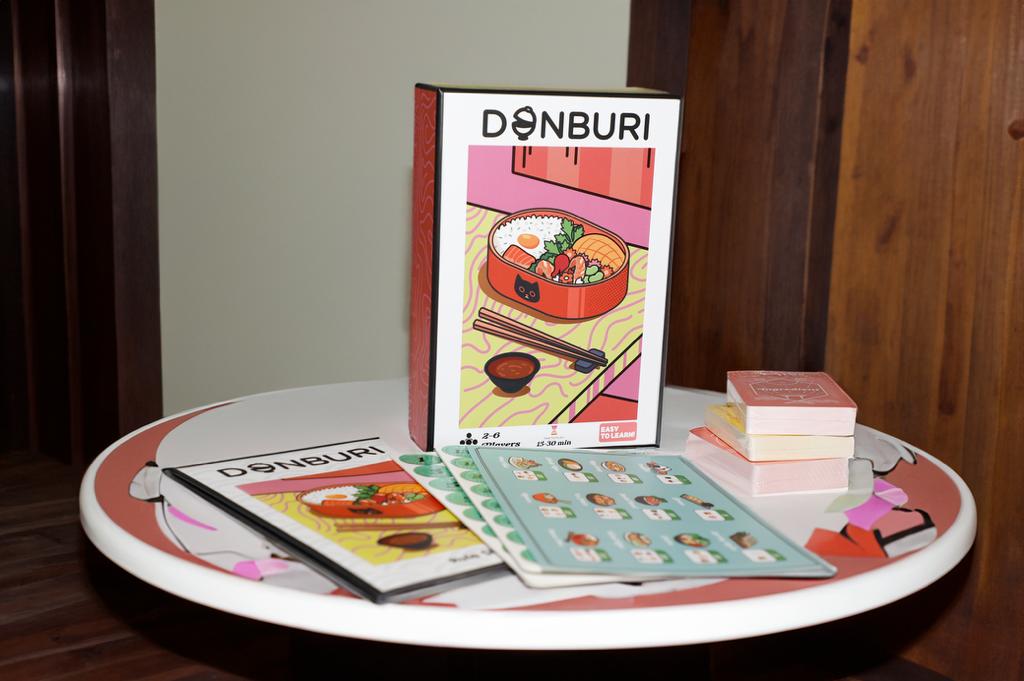
The physical product was something I cared a lot about because I think the unboxing experience sets the tone for how people perceive the game before they even play it. I wanted it to feel like you're opening an actual bento box, where everything has its place and is neatly arranged for you to discover. Inside, the rule sheet, reference card, point tokens, and card decks are all designed around the same visual system with consistent colors, icons, and typography so nothing feels like an afterthought. The green point tokens, teal reference sheet, red ingredient cards, and yellow special cards each have their own distinct color so you can immediately tell what's what when you open the box. The rule sheet carries the same cover art, so when you lay everything out on the table, it reads as one cohesive thing rather than a bunch of separate pieces that were just thrown together.
Design Decisions
The whole visual identity started with illustration styles I was seeing on Behance. I wanted that bright, saturated, cartoony look where everything pops off the surface, and it made sense for a game literally themed around building donburi bowls. Every card uses bold outlines and flat color fills so the ingredients are instantly recognizable even when you're holding a hand of cards and glancing quickly. The red and yellow card backs tie into that same warm, food-inspired palette, and the teal reference sheet acts as a nice contrast piece so it's easy to spot on the table mid-game. I also snuck a little black cat face onto the bento box on the cover, which was just a small personality touch to make the brand feel less generic and more memorable.
I spent a lot of time thinking about how the cards would actually feel during gameplay. The ingredient cards needed to communicate what they are instantly, so each one has a large centered illustration with the name right below it and the point value clearly visible. The "action" cards use a completely different color treatment (yellow instead of red) so you can immediately tell they're special cards before reading any text. I kept the card text minimal on purpose because nobody wants to stop mid-turn and read a paragraph. If the card art and layout can't explain themselves in a couple seconds, something went wrong in the design.
The physical product was something I cared a lot about because I think the unboxing experience sets the tone for how people perceive the game before they even play it. I wanted it to feel like you're opening an actual bento box, where everything has its place and is neatly arranged for you to discover. Inside, the rule sheet, reference card, point tokens, and card decks are all designed around the same visual system with consistent colors, icons, and typography so nothing feels like an afterthought. The green point tokens, teal reference sheet, red ingredient cards, and yellow special cards each have their own distinct color so you can immediately tell what's what when you open the box. The rule sheet carries the same cover art, so when you lay everything out on the table, it reads as one cohesive thing rather than a bunch of separate pieces that were just thrown together.
Further Development
In terms of further development, I have yet to mass manufacture this card game but was able to develop a sample for playtesting and getting further user feedback.
I hope to eventually mass manufacture this game when I am able to get more free time and hope to add different variations to this game as well as create a Kickstarter campaign for this game.
Further Development
In terms of further development, I have yet to mass manufacture this card game but was able to develop a sample for playtesting and getting further user feedback.
I hope to eventually mass manufacture this game when I am able to get more free time and hope to add different variations to this game as well as create a Kickstarter campaign for this game.
Further Development
In terms of further development, I have yet to mass manufacture this card game but was able to develop a sample for playtesting and getting further user feedback.
I hope to eventually mass manufacture this game when I am able to get more free time and hope to add different variations to this game as well as create a Kickstarter campaign for this game.