MainQuest
MainQuest
MainQuest
Mobile App
Mobile App
Mobile App
Overview
Overview
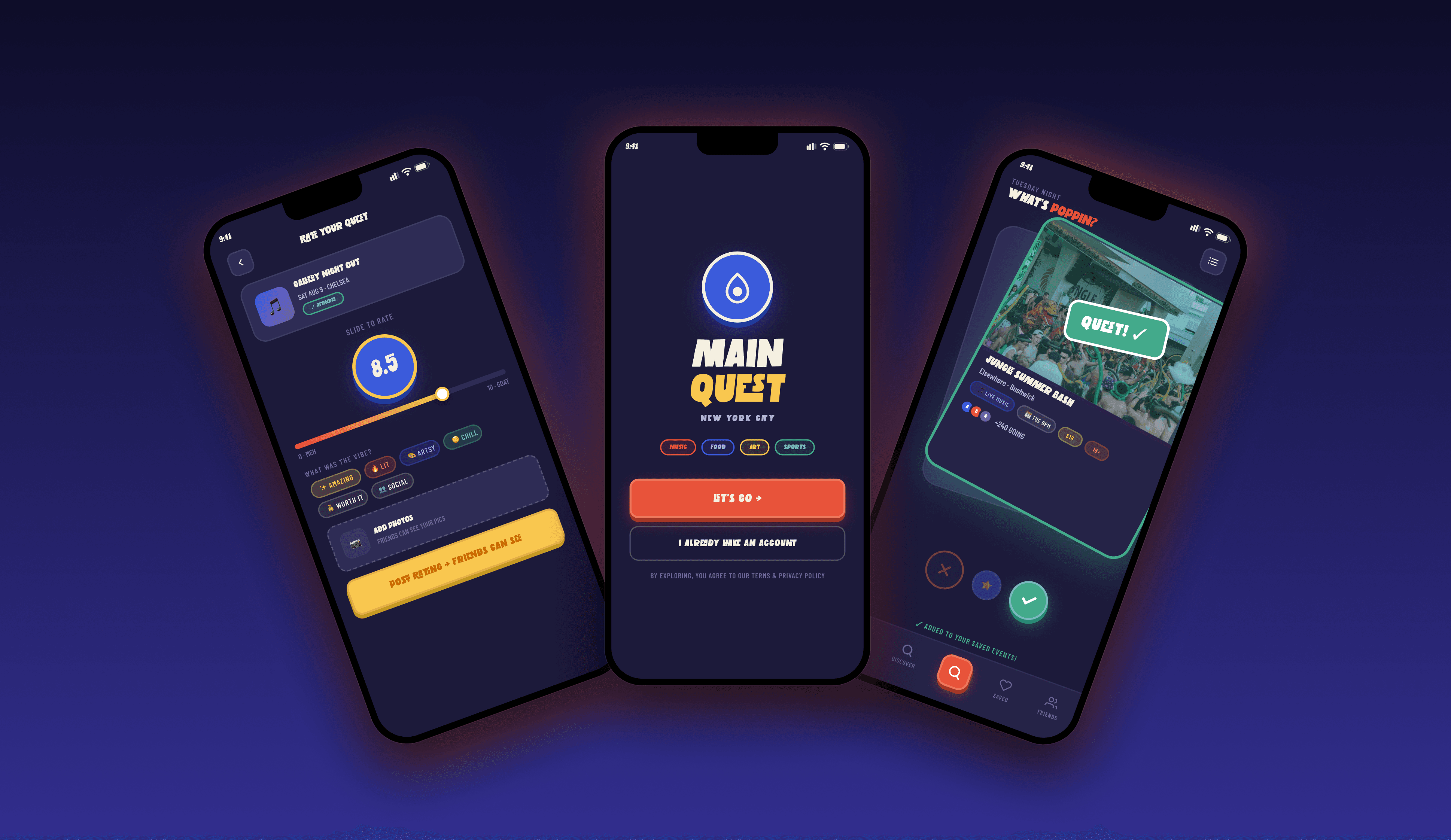
MainQuest is an app that allows users to find free activities in NYC. It uses a dating app-style format: users set preferences (location, price, type of activity) and then can either discard or save the event. It also includes a social aspect that lets users see their friends’ saved events and collaborate.
MainQuest is an app that allows users to find free activities in NYC. It uses a dating app-style format: users set preferences (location, price, type of activity) and then can either discard or save the event. It also includes a social aspect that lets users see their friends’ saved events and collaborate.
The overall concept was inspired by a conversation with my friends when we talked about how all we do when we're together is eat and spend money. As a student studying in New York, I realized searching for fun free activities was extremely tedious and difficult to find which inspired the app concept and demo. The app allows people to find fun, new activities around NYC based on their preferences. For how the app works, I decided to mimic the style of popular dating apps (swiping), which is trendy and relevant to the age and target demographic of people we would expect to use this website. This makes the app more interactive and enjoyable for users as well as having that social feature of being able to have your friends on the app as well.
The overall concept was inspired by a conversation with my friends when we talked about how all we do when we're together is eat and spend money. As a student studying in New York, I realized searching for fun free activities was extremely tedious and difficult to find which inspired the app concept and demo. The app allows people to find fun, new activities around NYC based on their preferences. For how the app works, I decided to mimic the style of popular dating apps (swiping), which is trendy and relevant to the age and target demographic of people we would expect to use this website. This makes the app more interactive and enjoyable for users as well as having that social feature of being able to have your friends on the app as well.
Tools Used
Figma
Design Tool

Visual Studio Code
IDE
Tools Used
Figma
Design Tool
Visual Studio Code
IDE
Tools Used
Figma
Design Tool
Visual Studio Code
IDE
Created
Created
2026
Process
Process
User Flow
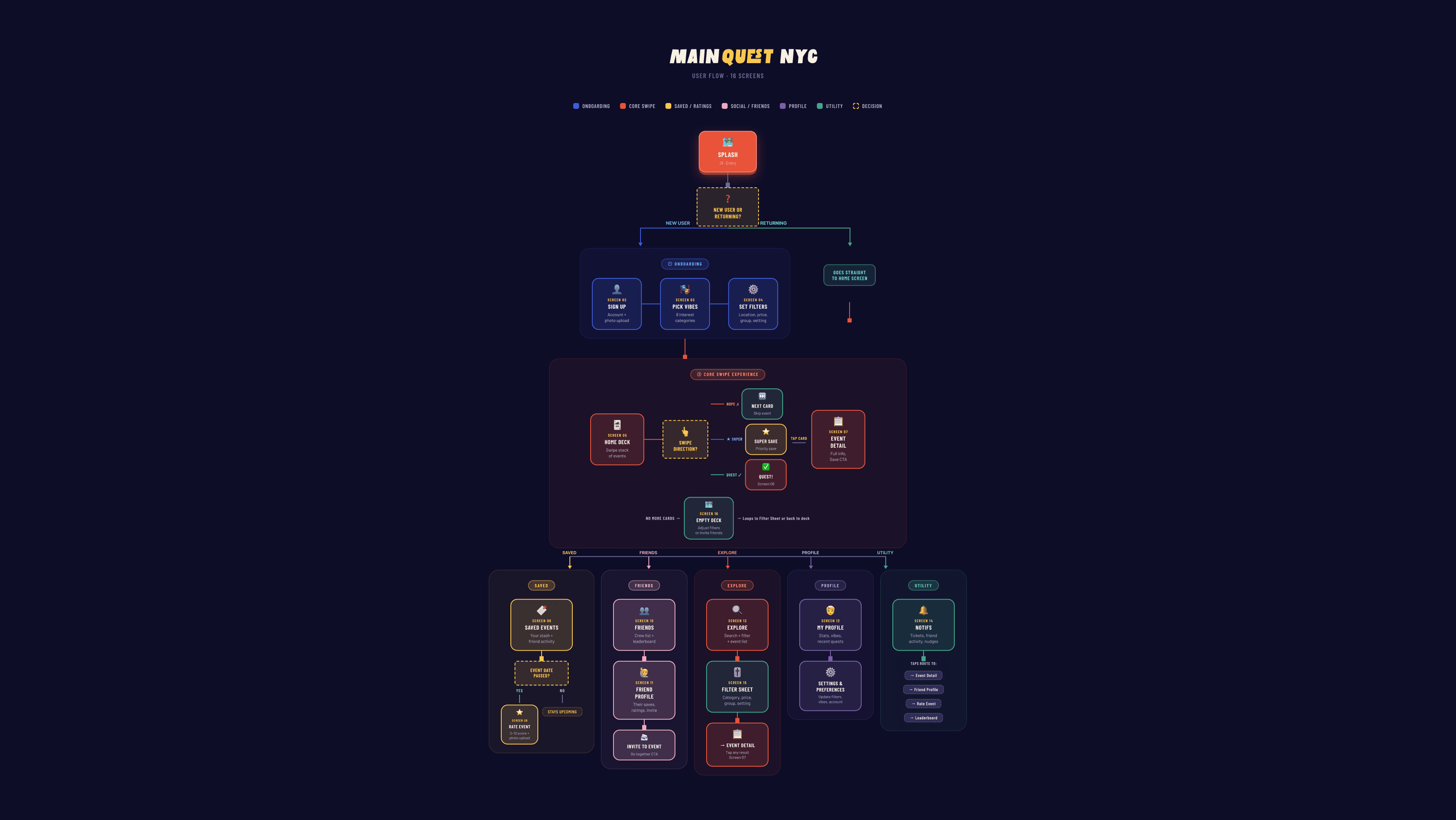
When designing the user flowchart, I wanted the user experience to be as simple as possible. It starts with the basic sign-up/sign-in page and then has 5 main pages (saved, friends, explore, profile, and settings/utility). The main differentiator that makes the user flow more interactive is the ability to swipe yes and no to various types of events as well as set preferences for types of activities.
To create the user flow chart, I took heavy inspiration from Hinge, which is one of the most popular apps for the intended demographic for this app. By mimicking their user flow, I knew that many users of the intended demographic would be easily familiar with how the app works, lowering user friction. I also took inspiration from Beli when creating how the flow of the social aspect of the app works as well.
Design Decisions
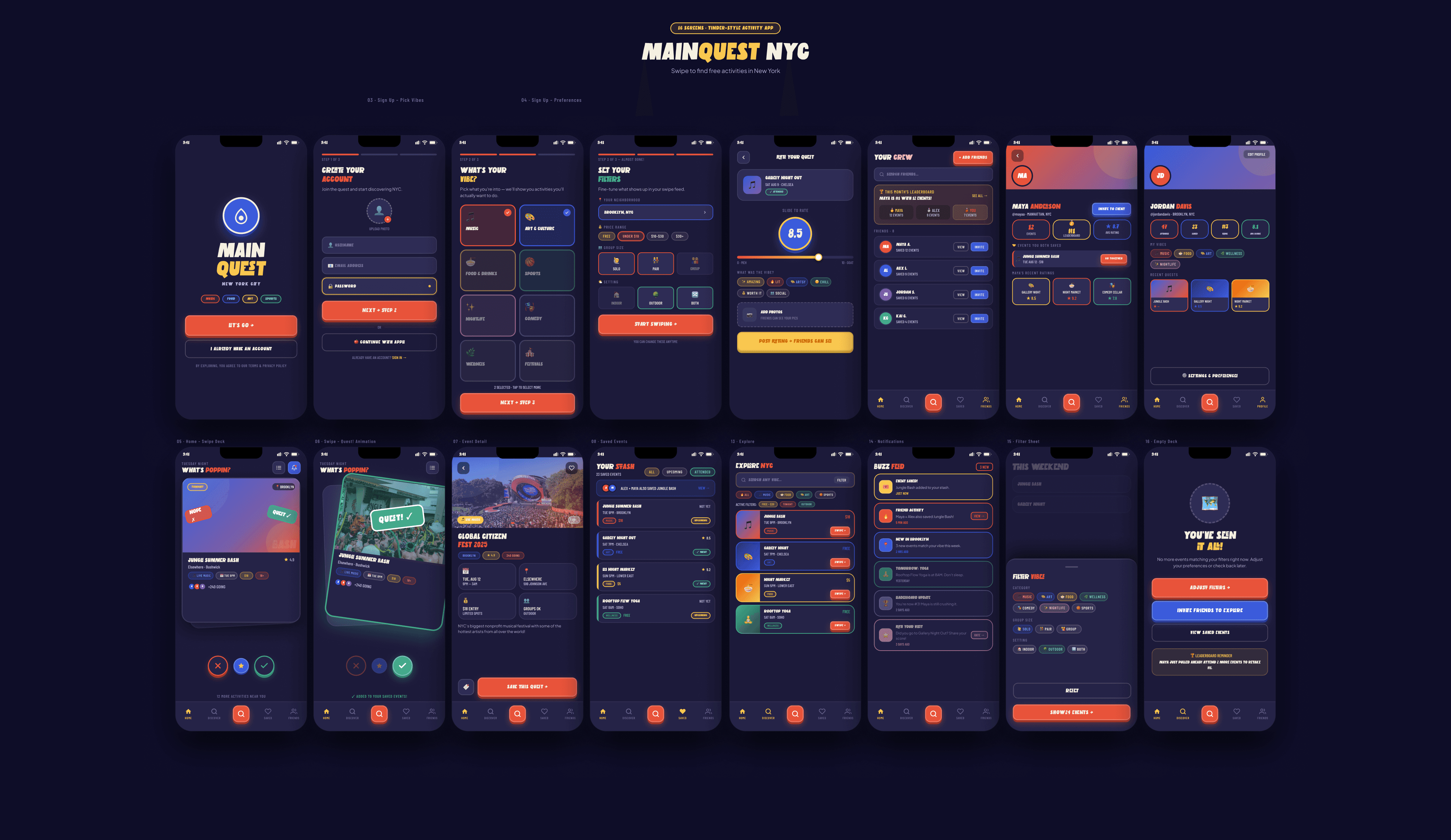
For the aesthetic of the UI/UX, I wanted the colors to be vibrant and playful to really replicate the variety of NYC. I took inspiration from various UI/UX designs from both Dribble and Behance when deciding the fonts and color palette.
Since this was a demo for a club at NYU, I kept the scope tight and focused on making the experience feel real rather than building infrastructure that didn't need to exist yet. I manually sourced around 95 unique free NYC events from nycforfree.co, organized them into a structured database with fields like category, group size, setting, and date, and used that as the backend for everything. The UI was designed around the filter system you see in the app (Music, Art, Food, Wellness, Comedy, Nightlife, and Sports) so users could actually narrow things down to what they're in the mood for rather than just seeing a random dump of events.
Design Decisions
For the aesthetic of the UI/UX, I wanted the colors to be vibrant and playful to really replicate the variety of NYC. I took inspiration from various UI/UX designs from both Dribble and Behance when deciding the fonts and color palette.
Since this was a demo for a club at NYU, I kept the scope tight and focused on making the experience feel real rather than building infrastructure that didn't need to exist yet. I manually sourced around 95 unique free NYC events from nycforfree.co, organized them into a structured database with fields like category, group size, setting, and date, and used that as the backend for everything. The UI was designed around the filter system you see in the app (Music, Art, Food, Wellness, Comedy, Nightlife, and Sports) so users could actually narrow things down to what they're in the mood for rather than just seeing a random dump of events.
Design Decisions
For the aesthetic of the UI/UX, I wanted the colors to be vibrant and playful to really replicate the variety of NYC. I took inspiration from various UI/UX designs from both Dribble and Behance when deciding the fonts and color palette.
Since this was a demo for a club at NYU, I kept the scope tight and focused on making the experience feel real rather than building infrastructure that didn't need to exist yet. I manually sourced around 95 unique free NYC events from nycforfree.co, organized them into a structured database with fields like category, group size, setting, and date, and used that as the backend for everything. The UI was designed around the filter system you see in the app (Music, Art, Food, Wellness, Comedy, Nightlife, and Sports) so users could actually narrow things down to what they're in the mood for rather than just seeing a random dump of events.
Further Development
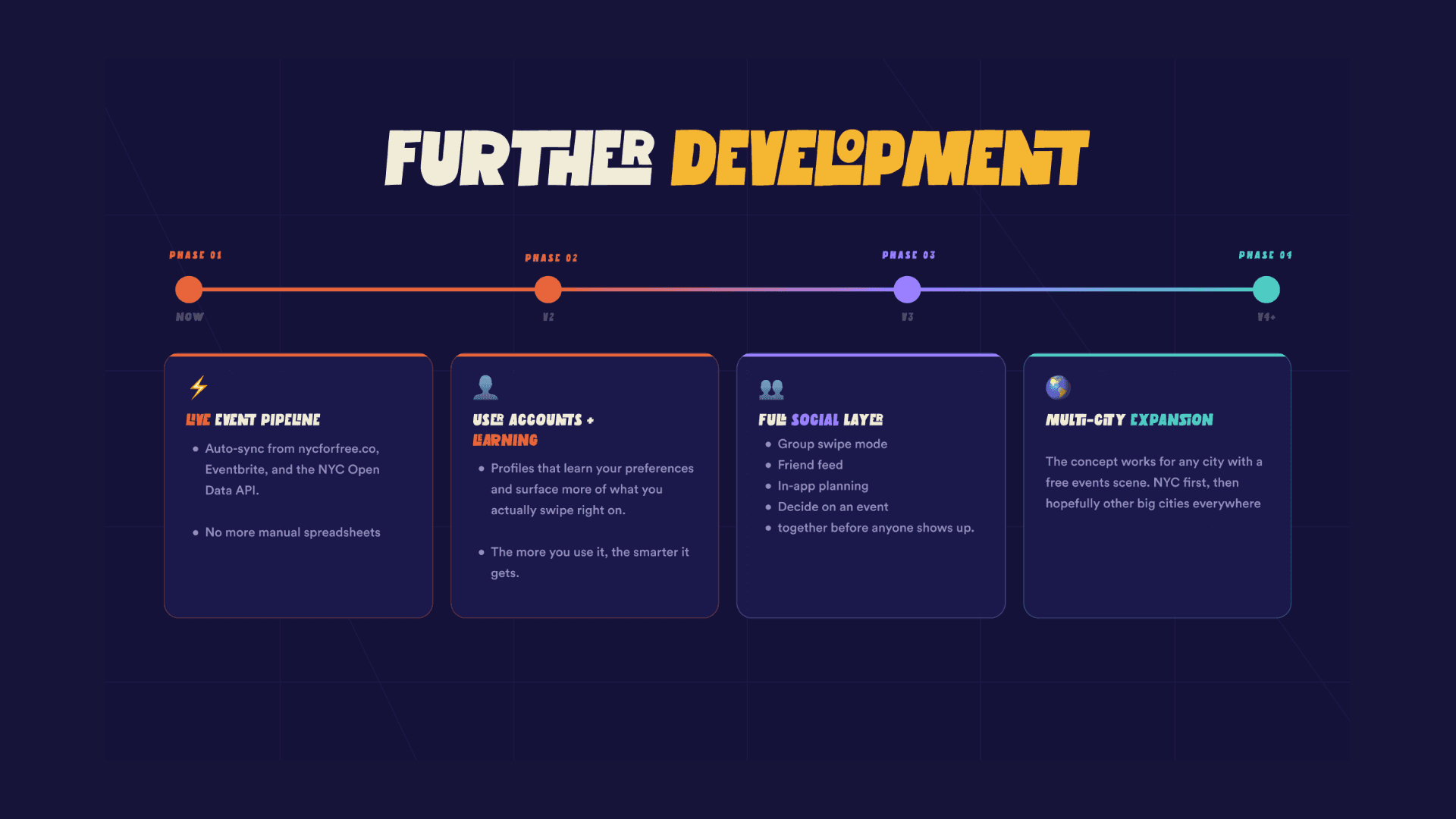
If I were to take MainQuest further, the biggest thing I'd want to build out is a real backend that pulls events automatically instead of a manually curated spreadsheet. Right now the database is static, which works fine for a demo, but at scale you'd want live event data syncing from sources like nycforfree.co, Eventbrite, and the NYC Open Data API so the app is always up to date without anyone having to touch it. On top of that, I'd want to add user accounts so the app actually learns what you like over time. If you keep swiping right on music and outdoor events, it should start surfacing more of that automatically rather than treating every session like a fresh start.
The social layer is also something I'd want to develop a lot more. The friends feature exists in the design but it's pretty surface level right now. Ideally you'd be able to see what events your friends saved, make plans together directly in the app, and maybe even have a group swipe mode where everyone votes on the same event. I'd also want to expand beyond NYC eventually. The core concept works for any city with a decent free events scene, so building out the infrastructure to support multiple cities would be the natural next step once the product is solid in one market.
Link to Full Presentation
The link below is the slide deck and functional demo we presented at the PMC x Salesforce pitch competition:
https://drive.google.com/file/d/1CWaH1159fJ9pmqL0RJjSWEJmv3qZtYnG/view?usp=sharing
Further Development
If I were to take MainQuest further, the biggest thing I'd want to build out is a real backend that pulls events automatically instead of a manually curated spreadsheet. Right now the database is static, which works fine for a demo, but at scale you'd want live event data syncing from sources like nycforfree.co, Eventbrite, and the NYC Open Data API so the app is always up to date without anyone having to touch it. On top of that, I'd want to add user accounts so the app actually learns what you like over time. If you keep swiping right on music and outdoor events, it should start surfacing more of that automatically rather than treating every session like a fresh start.
The social layer is also something I'd want to develop a lot more. The friends feature exists in the design but it's pretty surface level right now. Ideally you'd be able to see what events your friends saved, make plans together directly in the app, and maybe even have a group swipe mode where everyone votes on the same event. I'd also want to expand beyond NYC eventually. The core concept works for any city with a decent free events scene, so building out the infrastructure to support multiple cities would be the natural next step once the product is solid in one market.
Link to Full Presentation
The link below is the slide deck and functional demo we presented at the PMC x Salesforce pitch competition:
https://drive.google.com/file/d/1CWaH1159fJ9pmqL0RJjSWEJmv3qZtYnG/view?usp=sharing
Further Development
If I were to take MainQuest further, the biggest thing I'd want to build out is a real backend that pulls events automatically instead of a manually curated spreadsheet. Right now the database is static, which works fine for a demo, but at scale you'd want live event data syncing from sources like nycforfree.co, Eventbrite, and the NYC Open Data API so the app is always up to date without anyone having to touch it. On top of that, I'd want to add user accounts so the app actually learns what you like over time. If you keep swiping right on music and outdoor events, it should start surfacing more of that automatically rather than treating every session like a fresh start.
The social layer is also something I'd want to develop a lot more. The friends feature exists in the design but it's pretty surface level right now. Ideally you'd be able to see what events your friends saved, make plans together directly in the app, and maybe even have a group swipe mode where everyone votes on the same event. I'd also want to expand beyond NYC eventually. The core concept works for any city with a decent free events scene, so building out the infrastructure to support multiple cities would be the natural next step once the product is solid in one market.
Link to Full Presentation
The link below is the slide deck and functional demo we presented at the PMC x Salesforce pitch competition:
https://drive.google.com/file/d/1CWaH1159fJ9pmqL0RJjSWEJmv3qZtYnG/view?usp=sharing