
NFL Draft Prospect Analysis
NFL Draft Prospect Analysis
NFL Draft Prospect Analysis
Data Analytics
Data Analytics
Data Analytics
Overview
Overview
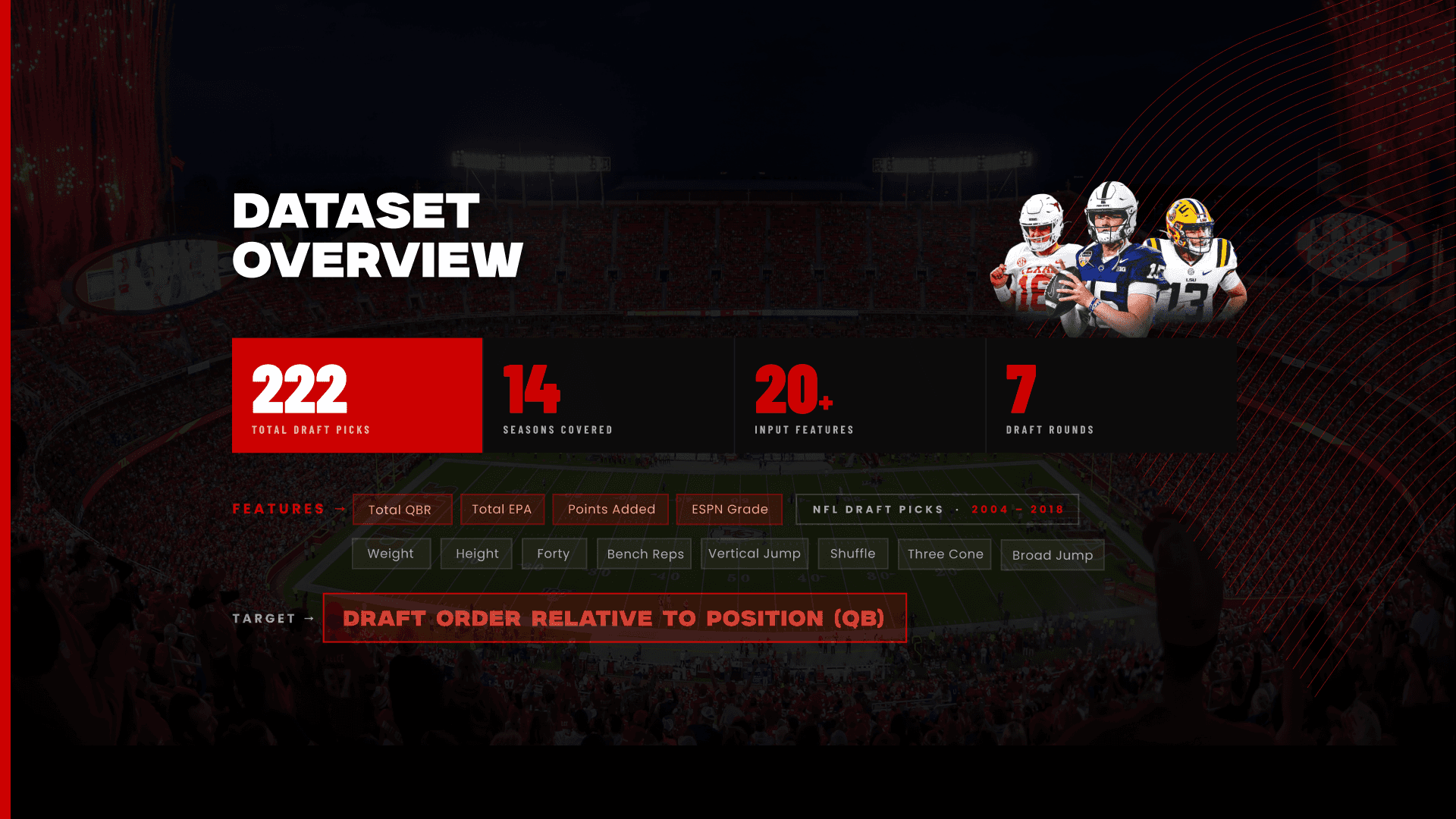
This was a group project as part of NYU Stern Business Analytics Club's Insight team, where six of us tried to figure out what actually predicts NFL draft success for quarterbacks. We pulled data on 222 QBs drafted between 2004 and 2018, combining college production stats, NFL Combine numbers, and pre-draft scouting grades to see which ones held up.
This was a group project as part of NYU Stern Business Analytics Club's Insight team, where six of us tried to figure out what actually predicts NFL draft success for quarterbacks. We pulled data on 222 QBs drafted between 2004 and 2018, combining college production stats, NFL Combine numbers, and pre-draft scouting grades to see which ones held up.
I worked with the team on building out the models, running everything from linear regression to random forest to compare how predictive each feature actually was. ESPN grade turned out to be the strongest single predictor of both draft position and career value, while combine numbers like the 40 time barely correlated with career success and draft position. Once we added scouting grades to a decision tree, the accuracy jumped from 89% to 94%, though that's partly expected since scouts already have a sense of where a player is going. The biggest thing I took away from this project was that no dataset can capture leadership, film study, or scheme fit. It's true that objective data gets you part of the way there when understanding a prospect, but scouting still does most of the real work. Link to full breakdown of the models, dataset, and findings is in the presentation below: https://drive.google.com/file/d/13Ba2Vy145S_OSFATVfcn2YMDij7RMz4f/view?usp=sharing https://docs.google.com/spreadsheets/d/1Vv01FWuNGzrFVgAnFMv4lLhXHYrCG4J4rmMg33krByM/edit?usp=sharing
I worked with the team on building out the models, running everything from linear regression to random forest to compare how predictive each feature actually was. ESPN grade turned out to be the strongest single predictor of both draft position and career value, while combine numbers like the 40 time barely correlated with career success and draft position. Once we added scouting grades to a decision tree, the accuracy jumped from 89% to 94%, though that's partly expected since scouts already have a sense of where a player is going. The biggest thing I took away from this project was that no dataset can capture leadership, film study, or scheme fit. It's true that objective data gets you part of the way there when understanding a prospect, but scouting still does most of the real work. Link to full breakdown of the models, dataset, and findings is in the presentation below: https://drive.google.com/file/d/13Ba2Vy145S_OSFATVfcn2YMDij7RMz4f/view?usp=sharing https://docs.google.com/spreadsheets/d/1Vv01FWuNGzrFVgAnFMv4lLhXHYrCG4J4rmMg33krByM/edit?usp=sharing
Tools Used

Figma
Design Tool

Google Colab
Jupyter Notebook
Tools Used
Figma
Design Tool

Google Colab
Jupyter Notebook
Tools Used
Figma
Design Tool

Google Colab
Jupyter Notebook
Created
Created
2026